
How AI Transforms Content Creation for E-Commerce Success

E-commerce visual content production has entered a revolutionary phase. AI-driven visuals can reduce content production costs by up to 90% while simultaneously boosting conversion rates by double digits. Traditional product photography requires expensive equipment, professional photographers, studio time, and weeks of post-production editing. AI-powered tools compress this timeline from weeks to minutes, enabling entrepreneurs and digital marketers to scale visual content creation without proportional cost increases. This guide explores how AI technologies work, best practices for hybrid human-AI workflows, measurable conversion improvements, and critical authenticity considerations for implementing AI content strategies that drive sales performance.
Key Takeaways
| Point | Details |
|---|---|
| Cost and speed gains | AI driven visuals can cut production costs by up to ninety percent and reduce timelines from weeks to minutes, enabling rapid content scale. |
| AI generation methods | GANs, diffusion models, and multimodal AI power visual creation by learning lighting, texture, and styling from large image datasets. |
| Hybrid workflow benefits | Structured human in the loop processes improve accuracy and conversion performance compared to fully automated or manual approaches. |
| Conversion impact evidence | Measured improvements in conversion rates are demonstrated through case studies and real world implementations. |
Understanding how AI creates visual content
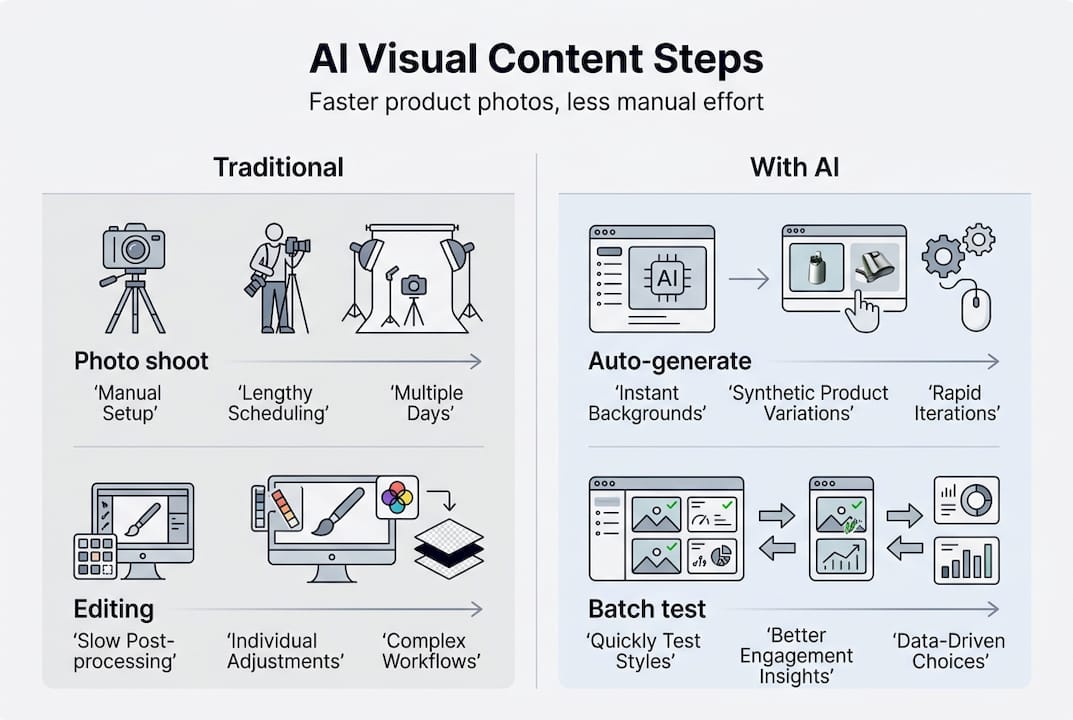
Artificial intelligence generates e-commerce visuals through three primary technological approaches that have matured dramatically over the past few years. Generative adversarial networks (GANs) and diffusion models generate realistic images by training on millions of product photographs to learn patterns in lighting, composition, and texture. GANs operate through two competing neural networks: one generates images while the other critiques them, creating an iterative refinement process that produces photorealistic results. Diffusion models work differently, starting with random noise and gradually refining it into coherent images based on text descriptions or reference photos.
Multimodal AI represents the cutting edge for e-commerce content creation. These systems process multiple input types simultaneously, allowing you to upload a basic product photo and transform it into professional marketing videos, lifestyle context images, or seasonal variations without reshoots. The technology recognizes objects, understands spatial relationships, and applies consistent styling across generated variants. For instance, you can input a single shoe photograph and generate images showing that shoe in outdoor settings, on different surfaces, or worn by diverse models.
The practical implications transform content workflows:
- Background replacement happens in seconds instead of hours of manual masking
- Lighting adjustments require simple text prompts rather than expensive studio setups
- Product variants across colors and materials generate automatically from one master image
- Resolution upscaling transforms low-quality supplier photos into high-resolution marketing assets
- Seasonal and contextual variations create without additional photography sessions
These AI techniques compress what traditionally required weeks of photographer coordination, studio booking, and post-production editing into automated processes that run while you sleep. The speed advantage enables rapid testing of visual strategies, immediate response to trending aesthetics, and personalized content at scales impossible with human-only production. Understanding these underlying technologies helps you select appropriate tools and set realistic expectations for what AI can and cannot accomplish in your specific e-commerce context.
Best practices and workflows for hybrid AI-human content creation
Successful AI content implementation requires structured workflows that combine automation efficiency with human judgment. Human-in-the-loop workflows with AI drafts followed by human quality assurance improve accuracy and conversion performance compared to fully automated or fully manual approaches. The optimal workflow follows four distinct stages that balance speed with quality control.
Creation stage: Use AI tools to generate initial visual assets based on product specifications, brand guidelines, and campaign objectives. Feed the system reference images, color palettes, and text descriptions that capture your desired aesthetic. Generate multiple variants to provide options for human review.
Optimization stage: Apply AI-powered editing for background removal, lighting enhancement, resolution upscaling, and minor corrections. This stage leverages AI's strength in repetitive technical tasks while preserving creative decisions for human oversight.
Approval stage: Human editors review AI-generated content for brand consistency, factual accuracy, and regulatory compliance. Check that product details match specifications, colors render accurately, and images align with your brand voice. Flag any AI hallucinations or texture inaccuracies for correction.
Distribution stage: Deploy approved visuals across marketing channels with appropriate metadata, alt text, and tracking parameters. Monitor performance metrics to identify which AI-generated variants drive superior engagement and conversions.
The TCR framework (Task-Context-Reference) dramatically improves AI output quality. Instead of vague prompts like "make this look professional," structure requests as: Task ("remove background and replace with minimalist studio setting"), Context ("for luxury skincare brand targeting women 35-50"), Reference ("match lighting and composition of attached example image"). This precision reduces revision cycles and produces usable content on first generation.
Hybrid workflows deliver measurable performance improvements. Brands implementing structured human-AI collaboration report conversion rate increases of 20-400% compared to baseline content. The human oversight catches AI inaccuracies that would erode customer trust, while AI automation enables content volume impossible with manual production alone.
Compliance considerations require human attention. FTC regulations mandate clear disclosure when AI generates material elements of marketing content. EU consumer protection laws impose similar transparency requirements. Your approval stage must verify that AI-generated visuals include appropriate disclaimers and accurately represent product characteristics to avoid regulatory penalties and customer dissatisfaction.
Measuring impact: conversion lifts and cost savings evidence
Empirical data from e-commerce brands demonstrates AI content's tangible business impact. Case studies show 31-45% conversion lifts from implementing AI-generated product visuals, with some categories experiencing up to 80% sales increases. These improvements stem from AI's ability to test visual variations rapidly, personalize imagery to audience segments, and maintain consistent quality across thousands of product SKUs.
The following table compares performance metrics across brands that implemented AI content strategies:
| Brand / Study | Conversion Increase | Engagement Lift | Cost Reduction |
|---|---|---|---|
| Fashion retailer case study | 45% | 2.3× click-through | 75% |
| Home goods marketplace | 31% | 1.8× time on page | 68% |
| Beauty brand campaign | 37% | 3.1× social shares | 82% |
| Electronics vendor | 23.7% | 1.6× add-to-cart | 71% |
| Multi-category average | 34% | 2.2× engagement | 74% |
Cost savings prove equally compelling. Traditional product photography costs $50–$300 per image when accounting for photographer fees, studio rental, equipment, models, and post-production editing. AI tools reduce this to $0.50–$5 per image, enabling brands to allocate budget toward testing and personalization rather than basic content production. One mid-sized apparel brand reported saving $180,000 annually by replacing 60% of their photography needs with AI-generated visuals.
Key performance indicators showing consistent improvement include:
- Product page bounce rates declining 15–25% with enhanced AI visuals
- Average order values increasing 12–18% when lifestyle context images supplement product shots
- Return rates improving 8–14% due to more accurate visual representations
- Content production velocity accelerating 5–10× enabling rapid seasonal updates
- A/B testing capacity expanding from dozens to thousands of variants monthly
"AI-generated personalized product images delivered 26 times higher engagement than standard visuals in our campaign testing, directly translating to measurable revenue growth." - IBM and Adobe joint marketing case study analysis
The conversion improvements stem from several factors. AI enables testing visual hypotheses at scale, identifying which backgrounds, lighting conditions, and compositional styles resonate with specific customer segments. Personalization becomes economically viable when you can generate hundreds of image variants without proportional cost increases. Consistency across product catalogs improves when AI applies uniform styling, lighting, and quality standards that human photographers struggle to maintain across thousands of SKUs.

However, these benefits require disciplined implementation. Brands achieving superior results invest in proper AI tool selection, structured workflows with human oversight, and systematic performance measurement. The data clearly demonstrates that AI content creation delivers measurable business value when applied strategically rather than as a wholesale replacement for human creativity.
Risks, nuances, and the authenticity challenge
AI content generation introduces specific risks that require active management to protect brand reputation and customer satisfaction. AI-generated visuals can cause 23% more returns due to texture and color inconsistencies, particularly with complex materials like knitwear, leather, and fabrics with intricate patterns. Current AI models struggle to accurately render how light interacts with textured surfaces, leading to images that misrepresent product appearance and disappoint customers upon delivery.
Regulatory compliance creates legal obligations. FTC guidelines require transparent disclosure when AI generates material portions of marketing content, especially if those visuals could mislead consumers about product characteristics. European Union consumer protection regulations impose similar transparency requirements, with penalties for deceptive marketing practices. Your content workflows must include verification that AI-generated images accurately represent products and include appropriate disclaimers where regulations mandate disclosure.
Brand consistency challenges emerge when multiple team members generate content using different AI tools and prompts. Without centralized guidelines and approval processes, your visual identity fragments across channels. AI systems trained on generic datasets may default to aesthetic trends that conflict with your established brand voice, requiring human oversight to maintain coherent visual storytelling.
The authenticity paradox presents a strategic dilemma. Consumer research indicates growing preference for authentic 'messy' content over polished AI imagery, particularly among younger demographics skeptical of synthetic perfection. Overly perfect AI-generated visuals can trigger uncanny valley responses, where customers sense something artificial even if they cannot articulate specific flaws. This perception erodes trust and reduces conversion effectiveness despite technical quality.
Specific risk categories requiring mitigation:
- Texture inaccuracies in fabric, leather, wood grain, and reflective surfaces
- Color shifts between AI-generated images and actual product appearance
- Anatomical errors when AI generates images featuring hands, faces, or body proportions
- Copyright concerns if AI training data included proprietary competitor images
- Cultural insensitivity when AI defaults to stereotypical representations
- Accessibility failures if AI-generated images lack proper alt text and descriptions
The solution lies in transparent hybrid approaches. Disclose AI usage where appropriate, maintain human oversight for quality control, and reserve AI for applications where its strengths (speed, volume, consistency) outweigh its limitations (texture accuracy, authentic imperfection). Brands successfully navigating these challenges treat AI as a production accelerator rather than a wholesale replacement for human creativity and judgment.
Explore AI-powered content solutions with RogerApp
Implementing the strategies outlined requires selecting AI tools specifically designed for e-commerce visual content challenges. RogerApp offers advanced AI-driven capabilities specialized for product photography enhancement, background replacement, lighting optimization, and resolution upscaling without expensive photoshoots or lengthy production timelines. The platform supports the hybrid human-AI workflows discussed throughout this guide, enabling your team to generate high-volume visual variants while maintaining brand consistency and quality control.
RogerApp's suite addresses common e-commerce pain points: transforming supplier photos into marketing-ready assets, creating seasonal and contextual variants from master images, and scaling visual content production to match your catalog growth. The platform prioritizes user privacy and GDPR compliance while granting full commercial ownership rights to generated images, ensuring your visual assets remain proprietary business resources rather than shared training data.
Try RogerApp →Frequently asked questions
What types of AI tools are best for e-commerce visual content?
Generative adversarial networks and diffusion models excel at creating photorealistic product images from text descriptions or reference photos. Multimodal AI systems enable transforming static images into video content, generating seasonal variants, and creating lifestyle context without additional photography. Choose tools offering background replacement, lighting adjustment, resolution upscaling, and batch processing capabilities for maximum e-commerce utility.
How can e-commerce brands ensure AI content aligns with their brand identity?
Implement structured approval workflows where human editors review all AI-generated content for brand consistency before publication. Develop detailed prompt templates incorporating your brand guidelines, color palettes, and aesthetic preferences to guide AI output. Maintain centralized asset libraries with approved examples that team members reference when generating new content, ensuring visual coherence across channels and campaigns.
What measurable benefits can AI content creation bring to e-commerce sales?
Documented case studies report conversion rate increases of 31–45%, with some product categories experiencing up to 80% sales improvements from AI-enhanced visuals. Content production costs typically decline 60–90%, enabling brands to reallocate budget toward testing and personalization. Engagement metrics show improvements up to 26 times baseline performance when AI enables personalized visual content at scale, directly translating to revenue growth.
Are there risks of consumer backlash using AI-generated images?
Growing consumer segments, particularly younger demographics, express preference for authentic imperfect content over synthetic polished imagery. Transparency about AI usage and maintaining human involvement in creative decisions help mitigate trust concerns. Balanced strategies using AI for supporting visuals while preserving human photography for hero images and texture-critical products reduce authenticity backlash while capturing AI's efficiency benefits.